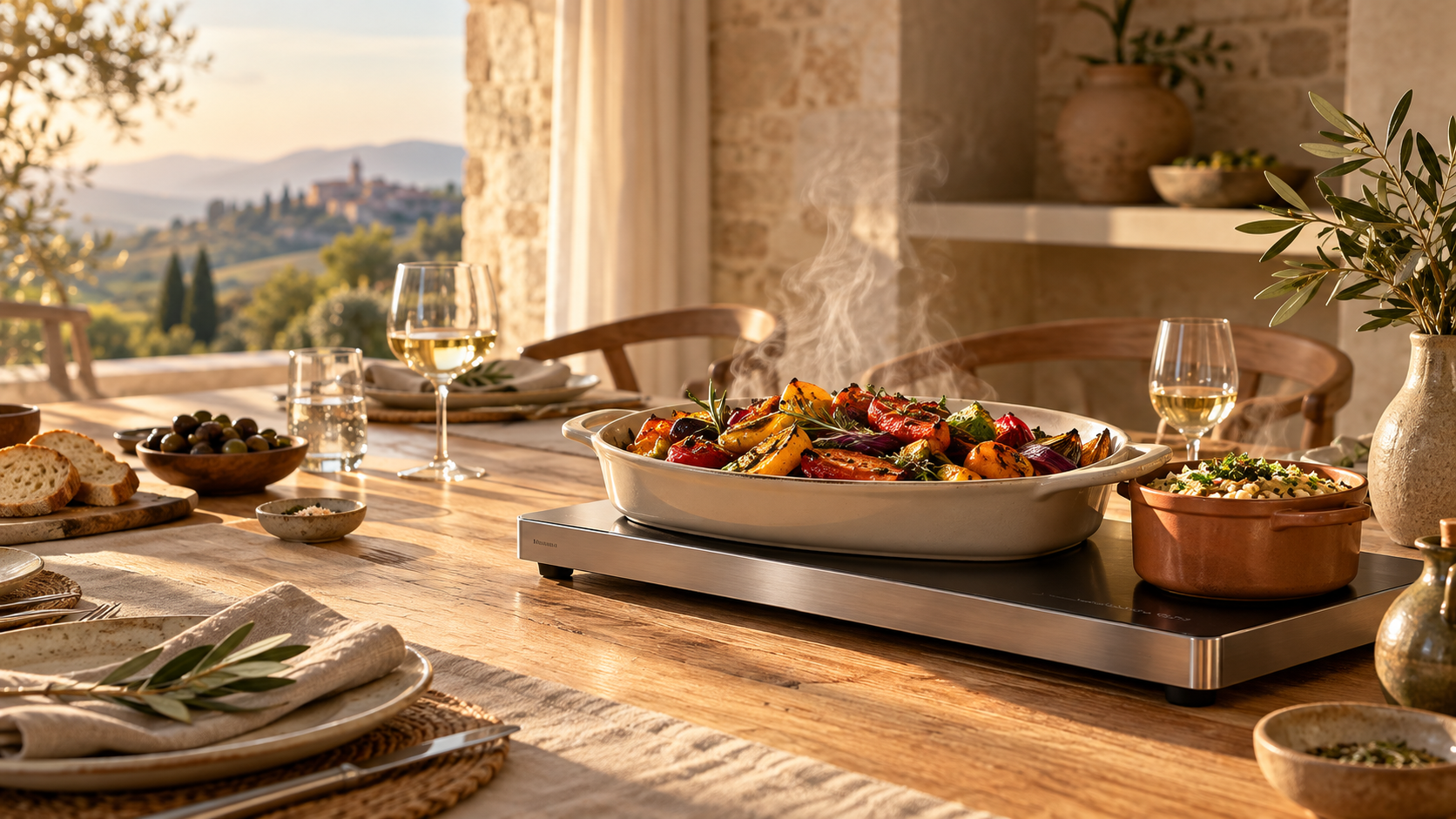


Warming plate
Warming plates for hot dishes and relaxed moments of enjoyment
A good warming plate ensures that food, drinks or dishes stay at a pleasant temperature for longer and are ready to be served exactly when they are needed. This is a real advantage, especially in everyday life, at family celebrations, buffets, breakfast groups or in the catering industry. Nobody wants freshly prepared food to cool down after just a few minutes or for plates and cups to unnecessarily reduce the enjoyment. With the right solution, hot dishes can be presented attractively and at the same time made available conveniently. Today there is not only the classic warming plate, but also a whole range of specialized variants for different requirements. Some models work electrically and offer constant heat output, others use tea lights and can be used particularly flexibly on the set table. There are also warming boxes for transport, warming containers for buffets, cup warmers for the desk or plate warmers for stylish service. If you choose the right equipment, you not only benefit from more comfort, but also from better organization when serving food. Whether for private invitations, use in the office or professional use: the decisive factors are size, area of application, temperature behavior, material and handling. A high-quality warming solution helps to keep food appetizing for longer, simplify processes and provide guests or customers with a pleasant experience. At the same time, it can make the difference between improvised serving and a well-thought-out concept. Below you will find out what types of warming systems there are, what they are suitable for and what you should pay attention to when buying so that you can find exactly the variant that suits your habits, your food and your space.
What types of warming systems are there?
If you are looking for a solution for keeping warm, you should first know the different device categories, because not every variant is suitable for the same requirements. The classic warming plate is a versatile choice for food on the table, at brunch or at smaller buffets. Electric models are particularly in demand when a constant temperature over a longer period of time is important. If you are specifically looking for such devices, you can find them on the subpage Electric Warming Plate appropriate information for this category. If, on the other hand, you want to keep food warm without electricity, solutions with candles or tea lights are an option. These are decorative, mobile and often ideal for private use. A suitable addition to this is the page Food warmer with Tealight, on which this uncomplicated form of keeping warm can be classified thematically. There are also devices that are specifically designed for food, such as warming plates for prepared dishes, buffet solutions or warming surfaces for several portions at the same time. In addition to openly usable panels, closed systems also play an important role. Warming containers are useful when food needs to be kept protected and served warm at the same time, while warming boxes are particularly practical when food needs to be transported or kept at the right temperature between the kitchen and the serving area. There are also special solutions such as plate warmers, cup warmers, soup warmers or sausage warmers, each of which is tailored to specific dishes or serving situations. The selection shows that it's not just about a single plate, but about a whole range of warming systems for different needs. Anyone who entertains guests, plans several courses or wants to serve dishes attractively over a longer period of time will benefit from knowing the differences. Only when it is clear whether mobility, temperature accuracy, capacity or presentation are in the foreground can the right solution be selected in a meaningful way.
The right solution for households, offices and restaurants.
The ideal area of application largely determines which type of warming system is worthwhile. In private households, the focus is often on comfort, ease of use and space-saving storage. For example, if you have brunch on the weekend, entertain guests or want to keep food warm at the dining table for longer, you would be well advised to use a compact warming plate or a decorative food warmer. For taking away or temporarily storing warm food, a Warming box be particularly practical, for example when transporting to celebrations, garden parties or family visits. If multiple components are served at the same time, a protected system makes sense. Then a Warming containers be a good choice because food can be better organized, stored hygienically and served in portions. In the office, the focus often shifts towards small, personal helpers. Cup warmers are particularly popular there because coffee or tea stays edible for longer at work. Compact warming plates can also be useful for short lunch breaks if there is no large kitchen. In the catering industry and professional buffets, the requirements are increasing significantly. What counts here is resilience, temperature stability, easy-to-clean materials and an efficient process. Warming plates with larger surfaces, buffet warmers, chafing dish solutions, soup warmers or sausage warmers help to offer food of consistent quality. The presentation also plays an important role, because guests should not only eat warm, but also have a well-kept buffet. Catering, breakfast buffets, hotel service or event catering therefore require systems that can be integrated into different concepts. A household usually needs flexible all-rounders, while in the professional sector, robust special solutions are required. If you realistically assess your own commitment before purchasing, you will avoid unnecessary expenses and find a solution more quickly that is really convincing in everyday life. That's exactly why it's worth deciding not just based on the price, but also based on the specific use in the respective environment.
What you should pay attention to when buying
When buying a warming plate or a similar device, it's not just the basic function that counts, but above all the question of how well the model fits your needs. An important criterion is the type of heat source. Electrical devices are useful when food needs to be kept reliably warm over a longer period of time and an even temperature is particularly important. Models with tea lights, on the other hand, score points with their easy handling, independence from sockets and an often attractive look on the table. Size is just as important. A compact plate is often sufficient for small households, while larger areas or several containers are required for buffets, celebrations or catering. If you want to present complete dishes, you should also take a look at solutions for Hot plate for food throw, while for visible presentation and service concepts a warming display cabinet can be interesting. The material is also relevant: stainless steel appears robust and hygienic, glass can be visually elegant but needs to be handled carefully. Cleaning, operation and safety also play a major role. Removable inserts, smooth surfaces and stable feet make use much easier. Temperature control is a real advantage with electrical appliances because different foods require different amounts of heat. Soups, sausages, pastries or plates have different requirements than casseroles or hot drinks. You should also consider how frequently the device is used. Anyone who uses it regularly benefits from durable workmanship and solid technology. Simpler models may also be sufficient for occasional use. Last but not least, the available space is important: large buffet solutions make little sense if only a small kitchen is available. A good purchase is therefore the result of the interaction between frequency of use, type of food, space, energy source and cleaning effort. If you take these points into account in advance, you will not only get a functioning device, but also an aid that really makes everyday life easier and will be enjoyable in the long term.
More comfort when serving and enjoying
Warming systems are more than just practical kitchen aids, because they improve the entire serving experience. Anyone who has ever entertained guests knows the problem: while the first portions are already on the table, other components in the kitchen are cooling down. A suitable warming solution creates significantly more peace and quiet. Food can be prepared better, processes can be planned more relaxed and guests can be looked after more comfortably. This applies not only to main courses, but also to dishes and drinks. Preheated plates enhance the taste experience because the food does not cool down so quickly. For this reason, Plate warmer a sensible addition for everyone who values stylish serving. On a smaller scale, a Cup warmer make the difference, for example in the home office or on long working days when coffee and tea are not drunk straight away. Additional special solutions come into play for breakfast, brunch and buffets. Soup warmers keep liquid food ready to serve, sausage warmers are suitable for snack and buffet concepts and egg warmers ensure higher quality for breakfast offerings. This shows how diverse the benefits of such devices are. At the same time, they contribute to better planning because not everything has to be finished at the last moment. In the catering industry this means more efficient processes, in the home more serenity and in the office more comfort in everyday life. Modern warming plates and related devices are also visually impressive, as many models fit harmoniously into table and buffet concepts. Anyone who values enjoyment, order and a pleasant presentation is making a smart decision with a well-thought-out warming solution. In the end, it's not just about keeping food warm, but about making eating, drinking and serving more pleasant overall. This is exactly where the real added value of a good warming plate and its specialized alternatives lies.
FAQ about warming plates
1. What is a warming plate best suited for?
A warming plate is ideal for keeping food ready to serve over a certain period of time. It is particularly practical at buffets, family celebrations, brunches or when several people eat at different times. Depending on the model, plates or smaller containers can also be preheated or kept warm.
2. Which is better: electric or with a tea light?
This depends on the application. Electric warming plates make sense if a consistent temperature is important over a longer period of time. Models with tealights are flexible, decorative and independent of sockets. Tealight versions are often sufficient for private table use, but electrical devices are usually more convenient for buffets or frequent use.
3. What are the differences between a warming plate, a warming box and a warming container?
A warming plate keeps food open and at temperature on a warm surface. A warming box is more suitable for transport and temporary storage. A warming container also protects food and is particularly practical for buffets or for multiple portions. Which variant is suitable depends on whether you want to serve, transport or store.
4. Can you also keep plates or cups warm with a warming plate?
Yes, many models are also suitable for this. Preheated plates ensure that the food you serve stays hot for longer. There are also special cup warmers for drinks that are specifically designed for mugs and cups and are particularly suitable for the workplace or small kitchens.
5. What should you pay particular attention to when buying?
Important are the size, heat source, material, cleaning effort and the specific area of use. Anyone who frequently entertains guests should ensure there is enough space and a constant temperature. More compact models are sufficient for occasional use. The question of whether there is a power connection or whether mobility is important also plays a major role in the selection.